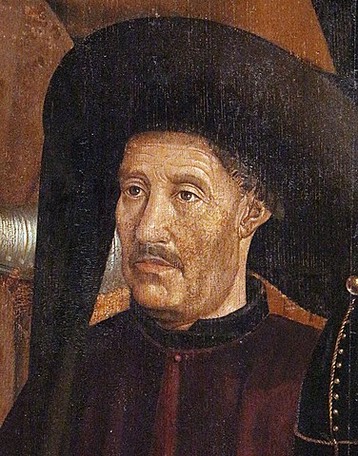
Portuguese prince, the Infante Henrique, Duke of Viseu (1394 – 1460), subsequently nicknamed Henry the Navigator, was the third surviving son of João I, founder of the House of Aviz, and Philippa, daughter of John of Gaunt and sister of England's Henry IV.
He seems to have been born in Porto, in the city's old mint, now known as the Casa do Infante (Prince's House), or in a nearby monastery in Leça da Palmeira. If that was not the case, the city provided the facility where he was baptised.
As an enthusiastic would-be Crusader, Henry encouraged his father to attack the prosperous Moorish port of Ceuta across the Straits of Gibraltar in northern Morocco. The city was a longstanding base for Barbary pirates who raided villages on the Portuguese coast, capturing their inhabitants to be sold in the African slave market.
Twenty-one-year-old Henrique distinguished himself alongside his father and brothers in the campaign. After the city fell in 1415, he became fascinated by aspects of the Saharan trade routes that terminated there and Africa in general.
That fascination can be seen to work on two levels. In the official version of events, as delivered by the chronicles and hagiographies, there is a desire to determine the exact extent of the Muslim domains.
Henrique was particularly intrigued by popular legends concerning Prester John, the Christian monarch supposed to rule a kingdom in the vicinity of modern-day Ethiopia.
In the words of one of his earliest non-Portuguese biographers:
This illustrious Henry having given proofe of his valour against the Infidels at Cepta, devised with himselfe, how he (being Governor of the Militarie Order of Jesus Christ, formerly instituted, and endowed to maintaine Warres against the Mores, alreadie expelled out of Portugall) might advance the honor of his Name and Order, in Conquests which others had not yet attempted, and therefore in Discoveries of Countries yet unknowne. To this end, he spent his life in single estate and in the studies of the Mathematikes : for which purpose, he chose the clearer Ayre of Cape S. Vincent, that there he might better intend his Mathematicall Theorie, the practike thereof in Instruments, and the use, in sending out Ships at his owne charge to discover remoter parts, whereof he had both heard by enquirie of Captives taken at Cepta, and conceived by his owne studie and reason (for besides that of Macham, ancient Histories give some light to the studious, in the 'reports of Menelaus, Hanno, Eudoxus, and others) that the Atlantike and Indian Seas had concourse, the one yeelding passage to the other, or rather being one continued Ocean. He also from Majorca caused one Master James, a man skilfull in Navigation, and in Cards and Sea Instruments, to be brought into Portugall, there at his charge, as it were, to erect a Schoole of Marinership, and to instruct his Countreymen in that Mysterie. (Samuel Purchas, Hakluytus Posthumus or Purchas His Pilgrimes, II, 10-11)
But there were more practical considerations.
There was a need to prevent Moorish pirate attacks along the Portuguese coast and to expand Portuguese trade. Most significant, from Henrique's point of view, they needed to locate the source of the caravans that brought gold across the desert to Ceuta.
The latter interest was a significant consideration for Dom Henrique.
Born a prince, he wished to be a king. Sprung from an impecunious and parvenu dynasty, which had seized the Portuguese crown as recently as1385, he wanted the sort of wealth that control of the gold trade promised. To make up for the lack of 'ancient riches,' which Aristotle defined as the criterion of true nobility, Henrique saturated himself in the prevailing aristocratic ethos of his day, the 'code' of chivalry. (Felipe Fernandez Armesto, Pathfinders: A Global History of Exploration, p. 130)
Such ambitions came with a hefty price tag, and the quasi-regal household of unruly 'knights and squires' whom Henrique maintained ... was not only evidence of Henrique's pretensions: it also committed him to seeking to fulfil them in order to generate patronage with which to reward his followers. (ibid., p. 132)
To do that, as verified by the account of one Diogo Gomes, a squire of his household who had participated in some of his patron's exploratory activities, he needed gold.
Not long after the capture of Ceuta, João Gonçalves Zarco and Tristão Vaz Teixeira, two squires in Henry's service, were despatched to explore along the African coast. Zarco had commanded caravels guarding the coast of Algarve against Moorish incursions, and both had been at Ceuta.
While it seems safe to assume they were looking for gold or anything else that might contribute to Henrique's coffers, details of their African explorations are unclear.
However, in 1418 they were reputedly on the return journey, exploiting the volta do mar westward swing into the Atlantic when a storm blew them off-course.
After finding shelter at an island they named Porto Santo, they returned to Portugal, reporting their discovery and suggesting that it might be a suitable location to colonise. Henry's biographer Peter Russell suggests that this was at best a rediscovery, Madeira, Porto Santo and Deserta, with their names attached, had appeared, more or less correctly located, on maps and seamen's charts from 1351 onwards, but since they were unpopulated had failed to attract the attention of"Italian or Iberian traders whose prime interest in any Atlantic islands was to take slaves. (Russell, Prince Henry, pp. 85-6)
In any case, Henry or his father ordered that Porto Santo be colonised, more than likely as a response to Castile's efforts to claim the Canary Islands. A plague of rabbits that devastated the island's crops prompted the settlers to move to the nearby island of Madeira in 1420. The governance of the archipelago was divided between Zarco and Tristão. They were subsequently appointed Captain-majors of Funchal and Machico.
In the meantime, his father had appointed Henry governor of the province of the Algarve in 1419. He took up residence at Sagres near Cape St. Vincent, Europe's southwesternmost point. The village he chose as the base for his future maritime enterprises became Vila do Infante (The Prince's Town).
There, according to the standard narrative, Henrique erected an observatory and established a formal school where, acting as a domine himself, he personally taught the science of oceanic navigation to sea-captains and pilots. (Russell, Prince Henry, p. 7)
In that version of events, those sea captains and pilots set out on the voyages that resulted in the discovery of the Azores and the Cape Verde Islands. They also explored the coast of Africa as far as Sierra Leone and established lucrative trading posts.
That reading also credits Henry with the development of the caravel. These much more manoeuvrable vessels could sail much nearer, or into, the wind. Therefore, they could operate more or less independently of the prevailing winds.
However, while Henry employed cartographers to chart the coasts his voyages encountered, and they may have worked at Sagres, there was no observatory or centre of navigation science in the modern sense of the word.
The conventional story also has Henry spending most of his time at Sagres.
Again, this does not seem to have been the case.
In May 1420, Henry became the Grand Master of the Military Order of Christ, Portugal's successor to the Knights Templar. That would have required a regular presence at the order's headquarters in central Portugal. On the other hand, the position delivered an essential source of funds for Henry's ambitious schemes, especially his persistent attempts to conquer the Canary Islands.
By the 1430s, his interest in the Canaries had grown into a well-documented obsession. Voyages to the neighbouring African coast were no more than a sideshow.
That focus changed over time, as his efforts in the Canaries came to little. Meanwhile, Africa began to yield exploitable commodities, particularly slaves and gold. The commercial activity was subsequently elevated with hindsight into a process of scientific exploration.
Still, there is no doubt that the prince was genuinely interested in cartographic and nautical matters. A diplomatic mission took his second brother, the Infante Peter, Duke of Coimbra, across Europe in 1425 and allowed the traveller to seek out geographic material. Peter returned from Venice with, among other things, a world map drafted by a Venetian cartographer.
Henry's financial interests improved when John I died in 1433 and Henry's eldest brother Edward (Duarte) succeeded to the throne. Duarte granted Henry the sole right to authorise expeditions beyond Cape Bojador and all the profits from trade within the areas he discovered. Henry already had his monopoly on tuna fishing in the Algarve. He also collected a 20% tax (o quinto) on the profits made by naval expeditions.
Most voyages departed from the nearby port of Lagos in one or two caravels, following the coastline by day, stopping at night and refusing to go beyond Cape Bojador, three hundred kilometres south of the Canaries.
The landmark, widely accepted as the most southerly point known to Europeans on Africa's desert coast, was, according to seafaring superstition, perilously close to the edge of the world.
Eanes skirted the shallows that extend thirty kilometres out from Bojador in 1434. He landed well beyond the cape and reputedly gathered a selection of familiar plants to bring back and shatter any remaining psychological barriers.
After that, the way was open for the rapid expansion of trade and exploration into previously unknown waters. However, the return leg of each voyage exploited the Volta do Mar ("turn of the sea") to overcome unfavourable winds and currents. It involved sailing to the west before turning to the northeast around the Azores, first discovered by Diogo de Silves in 1427 and charted more accurately by Gonçalo Velho four years later.
From there, eventually, more favourable following winds would take them home.
Nuno Tristão and Antão Gonçalves reached Cape Blanco in 1441. The Portuguese reached the Bay of Arguin in 1443. They built a fort on an island at the northern end of the Arguin Bank fishing grounds, which conveniently offered a perennial spring of excellent fresh water. Around 1448. Dinis Dias came across the Senegal River and rounded the peninsula of Cape Verde in 1444.
From 1444 to 1446, as many as forty vessels sailed from Lagos on Henry's behalf, and the first private mercantile expeditions began. Towards the mid-1450s, rather than relying on members of his household, Henry began to employ professional navigators, often from Genoa, as the delivery of increasingly profitable commodities transformed his finances.
By the time Henry died in 1460, Portuguese expeditions had explored the coast of Africa as far as present-day Sierra Leone. Twenty-eight years later, Bartolomeu Dias reached the Cape of Good Hope. In 1498, Vasco da Gama became the first European sailor to reach India by sea.
By this stage, the explorers had passed the southern boundary of the desert. They had circumvented and outflanked the Muslim land-based trade routes across the western Sahara.
It was not, however, a tale of ongoing success.
Henry was a primary organiser and leader of the disastrous expedition to Tangier in 1437. The expeditionary force set out from Portugal in August 1437 and laid siege to Tangier in mid-September. After a few failed assaults on the city, a Moroccan relief force encircled the Portuguese siege camp and starved it to submission. To extricate his army, Henry promised to return Ceuta to Morocco and gave his younger brother as a hostage.
Since the Portuguese Cortes refused to approve the return of Ceuta in exchange for the Infante Ferdinand, he remained in captivity until his death six years later.
Henry concentrated on his maritime activities and Portuguese court politics through the latter part of his life. Throughout his lifetime, no one referred to him as the 'Navigator'.
The term was coined by German historians Heinrich Schaefer and Gustav de Veer in the nineteenth century. Biographies by British authors Henry Major, Secretary of the Hakluyt Society and Keeper of Maps in the British Museum (1868) and Raymond Beazley (1895) played up Henry's English connections.
As the standard image of Henry — attributable to a chronicler in the prince's pay but uncorroborated elsewhere — fades, the emerging figure looks increasingly like a frustrated younger son with serious ambitions but lacking the avenues to fulfil them.
He seems to have inferred a sense of 'destiny' or 'vocation' from his horoscope and toyed with ideas of carving out his own realm, most consistently in the Canary Islands. However, he did look elsewhere as well.
Unable to embark on the voyages himself, he entrusted members of his "large, turbulent and expensive household of 'knights' and "squires' who practised chivalric rituals which in no way precluded a liking for violent crime". (Fernandez-Armesto, The Times Atlas, p. 63)
As far as his other avowed intent— expansion of the Christian faith— was concerned, the delivery never matched the declarations.
Still, regardless of the revisionists, Henry (or, more particularly, his household underlings) made two genuine contributions.
One involved the Volta do Mar ("turn of the sea") navigation triangle linking the Portuguese seaboard with west Africa, Madeira and the Azores.
The second was an extension of European knowledge of Africa's coast that set the scene for the rapid progress of exploration that followed in the 1470s and 1480s.
Sources:
Felipe Fernandez-Armesto (ed.) The Times Atlas of World Exploration
C. Raymond Beazley, Prince Henry the Navigator: the hero of Portugal and of modern discovery 1394-1460 A.D.
Chambers Biographical Dictionary
Miriam Estensen, Discovery: The Quest for the Great South Land
Richard Henry Major, The life of Prince Henry of Portugal surnamed the navigator and its results.
Peter Russell, Prince Henry' the Navigator': A Life
Time-Life History of the World: 1400–1500: Voyages of Discovery