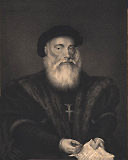
Portuguese navigator Vasco da Gama, 1st Count of Vidigueira (c.1469-1524), was the first European to sail around the Cape of Good Hope to Asia,
His initial voyage to India (1497–1499) set the stage for an age of global imperialism and laid the foundations for the long-standing Portuguese colonial empire in Asia. It was the longest sea voyage made up to that time: more than the Earth's circumference measured around the Equator.
Da Gama was born in Sines on the coast of Alentejo province in southwestern Portugal, the third son of a minor provincial nobleman. He was the local alcaide-mór (civil governor).
Little is known of his early life. However, he was probably educated in the inland town of Évora, studying mathematics, navigation and nautical science, and became a naval officer. He is reputed to have distinguished himself when he was sent to the port of Setúbal and the Algarve to seize French ships in retaliation for French depredations against Portuguese shipping.
His success on that mission may explain Manuel I's decision to give him the command of the expedition to follow up on Bartolomeu Dias' possible route to India around the Cape of Good Hope. The reasons behind the decision are not clear-cut. Da Gama was relatively young and inexperienced and may not have been the original choice. He may have inherited a commission for his father or his brother, Paulo.
His father died before work on the ships was complete, while Paulo had issues with his health. He eventually agreed to command the expedition's second carrack, the São Rafael.
The expedition's two carracks (da Gama's São Gabriel and his brother's vessel) were purpose-built for the voyage under Bartholomeu Dias' supervision. His experience suggested the task they were undertaking required something more substantial than the caravels he had used.
The expedition's third vessel, officially the São Miguel, nicknamed the Berrio, commanded by Nicolau Coelho, was a caravel, probably intended for reconnaissance duties. Gonçalo Nunes' 200-ton storeship rounded out the flotilla. It was never meant to go all the way to India and would end up scuttled in South Africa's Mossel Bay.
The three main ships carried experienced pilots — Pero de Alenquer, Pedro Escobar, João de Coimbra, and Afonso Gonçalves. They used tables and navigational instruments provided by Abraham Zacuto and maps and sailing directions from Diogo Ortiz, Bishop of Tangier. The fleet also carried three interpreters—two Arabic speakers and one who spoke several Bantu dialects and stone padrões to set up as marks of discovery along the way. Dias supervised the final preparations and accompanied the expedition as far as the Cape Verde Islands.
The four vessels, carrying a crew numbering around 170, sailed from Lisbon on 8 July 1497 and followed the standard Portuguese route along the African coast of Africa via Tenerife and Cape Verde.
The four ships passed the Canary Islands on 15 July and reached São Tiago off Cape Verde on the 26th. They remained there for about a week, then made a long, quite deliberate detour through the South Atlantic that would avoid adverse currents flowing along the African coast.
Over the ten years since Dias rounded the Cape, it seems safe to assume that unheralded voyages into the southern Atlantic delivered a better understanding of prevailing winds and currents.
After passing present-day Sierra Leone, da Gama took advantage of the prevailing winds. He sailed almost due south on a broad sweep through the open ocean, crossing the Equator in search of the South Atlantic westerlies Dias had discovered in 1487.
Once they found them, the four ships made landfall on the South African coast on 4 November 1497 after covering more than ten thousand kilometres out of sight of land.
Unfavourable winds and adverse currents meant the ships did not manage to pass the Cape of Good Hope until 22 November. Three days later, they anchored in Mossel Bay, erected a padrão, and broke up the store ship after transferring its contents to the other three vessels.
The remaining ships sailed again on 6 December. They passed Dias' furthest point at the Great Fish River on the 16th, celebrated Christmas off Natal, and reached the Quelimane River (their Rio dos Bons Sinais or River of Good Omens) a month later.
By early March, they had reached Mozambique, a city-state on the outskirts of the east African trade routes dominated by Muslim traders. Da Gama impersonated a Muslim to gain an audience with the Sultan, then managed to offend him with modest, unsuitable gifts. A hostile crowd forced the ships to withdraw from the harbour. Still, with a significant proportion of the crew affected by scurvy, they spent a month in the vicinity, repairing the ships and erecting another padrão while the ill recuperated.
The expedition turned to piracy in the waters off Kenya, looting unarmed Arab trading vessels. They became the first known Europeans to visit Mombasa (7 to 13 April), where the reception was hostile.
The welcome was friendlier when they arrived at Mombasa's regional rival, Malindi, on 14 April 1498. In the harbour, da Gama sighted the first signs of Indian rather than Arab traders. He managed to obtain the services of an experienced pilot who could use his knowledge of the monsoons to guide the three ships the rest of the way to Calicut on India's southwest coast.
When da Gama left Malindi on 24 April 1498, it had taken the Portuguese seventy years to feel their way down to the Cape and round it. The last leg, across the Indian Ocean, took a mere twenty-three days.
After they made landfall, the ships followed the coast to Calicut, which they reached on 20 May and erected a padrão to prove their accomplishment in reaching India. From there, however, things did not flow smoothly.
Calicut's ruler, the Samudiri (Zamorin), was away at his second capital when da Gama arrived but returned to Calicut to receive the visitors with traditional hospitality.
After a grand procession of three thousand armed Nair warriors, negotiations began but failed to produce satisfactory results. The gifts from Manuel I that da Gama delivered were trivial, insignificant, and failed to impress. The Zamorin refused his request for permission to leave a factor behind to move unsold merchandise. Worse, da Gama was expected to pay customs duty, preferably in gold.
Still, da Gama and his crew spent three months in Calicut, forced to barter on the waterfront if they wanted to gather goods for the passage home. As tension increased, da Gama fought his way out of the harbour at the end of August. He took five or six hostages who he expected to fill in the substantial gaps in the Portuguese knowledge of Indian customs and affairs.
Eager to head home, da Gama ignored local knowledge of monsoonal wind patterns. As a result, his ships inched north along the coast, anchored at Anjediva island and set out to cross the Indian Ocean on 3 October. While the outward crossing had taken just over three weeks, the return trip, sailing against the wind, took more than four months.
After sighting land again on 2 January 1499, they passed the Somali city of Mogadishu without stopping and finally arrived in Malindi on 8 January.
By that point, the expedition was in a terrible state. Roughly half of the crew died, with most survivors afflicted with scurvy. Without enough men to manage three ships, da Gama had the São Rafael scuttled and its crew split between the remaining two vessels. They set up the last padrão at Mozambique on 1 February, were back in Mossel Bay by early March, and rounded the Cape of Good Hope on the 20th. Favourable currents saw them off the West African coast by 25 April.
Around Cape Verde, Nicolau Coelho's Berrio separated from da Gama's São Gabriel and arrived in Lisbon on 10 July 1499. In the meantime, da Gama's brother, Paulo, had fallen grievously ill. Da Gama handed the São Gabriel over to João de Sá and remained at his dying brother's side. The São Gabriel reached Lisbon in late July or early August. While the da Gamas picked up a ride on a caravel bound for Portugal, Paulo died en route, and Vasco stopped off in the Azores to bury him. He eventually arrived in Lisbon in late August or early September to a hero's welcome on 9 September, having spent the intervening period mourning his brother.
He had been away almost two years, covered some 38,000 kilometres and returned with just fifty-five of his original complement of one hundred and seventy.
The expedition had failed to secure a commercial treaty with Calicut. Still, the spices on the remaining two ships returned a significant profit to the crown. While the voyage had only completed what others had begun, Manuel was undoubtedly grateful, anticipating further, more substantial returns from future ventures to the Indies.
Manuel awarded da Gama his hometown as a hereditary fief. However, that turned out to be a complicated matter since Sines belonged to the Order of Santiago, of which da Gama was a member. But the master of the Order refused to hand it over, fearful of setting a precedent that might see the king donate other properties belonging to the Order to other individuals. Da Gama's attempts to claim his reward estranged him from the Order, and he switched to the rival Order of Christ in 1507.
In the meantime, while he might not have his hometown, da Gama had a substantial pension and a hereditary title for himself and his descendants. As Admiral of the Seas of Arabia, Persia, India and all the Orient, he had the right to intervene in matters relating to any India-bound fleet and had married into the powerful Almeida clan. His wife was a first cousin of Dom Francisco de Almeida.
Several points were evident in the wake of da Gama's triumphant return.
For a start, future voyages needed to work around the Indian Ocean's weather patterns.
So the Portuguese needed to secure outposts where crews could recuperate from scurvy, collect provisions and wait out unfavourable weather.
It was also apparent that the yearly Portuguese Armadas sent to exploit da Gama's achievement would need to be substantial collections of vessels.
The Second India Armada, which departed in March 1500 under the command of Pedro Álvares Cabral, numbered thirteen ships.
The Third Armada, which departed in April 1501 under João da Nova, was smaller, with four ships and, perhaps, a supply ship to be dismantled along the way. Events in eastern waters meant that the Fourth was much larger.
Twenty vessels in three squadrons under da Gama departed in February and April 1502.
Cabral's fleet reached India in just six months and discovered Brazil en route. However, that may have been the official announcement of previously undisclosed landfalls.
The expedition's primary goal was a treaty with the Zamorin and a Portuguese factory in Calicut. That failed to eventuate. While Cabral did manage to get his factory there, conflict with local Arab merchant guilds saw it overrun in a riot with as many as seventy Portuguese killed. Cabral bombarded the city and withdrew. However, he managed to arrange an alliance with the ruler of Cochin, establish a factory there, and open relations with Cannanore, Cranganore and Quilon before he departed for Europe in January 1501. Cabral arrived home in July.
In the meantime, João da Nova had departed, so the reaction to the setbacks Cabral encountered would fall to da Gama's Fourth Armada.
Da Gama commanded a squadron of ten ships, with support from two flotillas of five ships commanded by his uncle Vicente Sodré and cousin Estêvão da Gama. The main fleet and the first support flotilla sailed in February 1502, called at the Cape Verdes and arrived in Sofala in East Africa in June. After establishing a factory in Mozambique, extorting tribute from the ruler of Kilwa, and negotiating a treaty with the ruler of the gold trading port of Sofala, they joined Estêvão da Gama's five ships which left home in April, at Malindi in August 1502.
Having terrorised Muslim ports along Africa's east coast, da Gama's fleet repeated the tactics after they arrived off the Indian coast in September. In the most notorious incident, da Gama seized a ship travelling from Calicut to Mecca and set it ablaze, killing several hundred pilgrims, including women and children.
After reducing Onor and Batecala to tribute, forging an alliance and establishing a factory at Cannanore, da Gama installed a new factor at Cochin. Finally, he arrived at Calicut seeking redress for Cabra's treatment.
He started by demanding that the Zamorin expel all the Muslims in the city. When the response from the shore was unsatisfactory, the ships bombarded the city for nearly two days, wrecked the city's port and killed thirty-eight hostages. They moved on to Cochin, south of Calicut, formed an alliance, and put an Arab fleet the Zamorin had hired to challenge the Portuguese armada to full flight off Calicut.
After loading the homeward bound ships with spices at Cochin and Cannanore, the Fourth Armada left Cannanore bound for Mozambique on 20 February 1503 and anchored in the Tagus on 11 October.
Da Gama left a squadron of caravels under his uncle, Vicente Sodré, to patrol the coast, harass shipping bound for Calicut, and protect the factories at Cochin and Cannanore. Still, things did not quite work out that way.
But when da Gama arrived in Portugal, he had failed in his primary mission, to bring the Zamorin to submission. That failure and the failure of Vicente Sodré to protect the factory in Cochin shaped subsequent appointments.
When Manuel considered candidates for the first Viceroy of Portuguese India in 1505, the post went to Francisco de Almeida. Almeida was succeeded by Afonso de Albuquerque, Lopo Soares de Albergaria, Diogo Lopes de Sequeira and the corrupt Duarte de Menezes. Eventually, da Gama found himself back in favour in 1524.
Da Gama continued to advise Manuel on Indian matters until 1505, then settled into retirement in Évora. Meanwhile, he argued with the Order of Santiago over Sines, which the Order refused to hand over.
In the meantime, his wife bore him six sons and a daughter, and the fallout over Ferdinand Magellan's defection to Castile in 1518 may have turned to da Gama's benefit.
He is reputed to have threatened to do the same, prompting Manuel to appoint him the first Count of Vidigueira. A royal decree on 29 December granted da Gama and his heirs all the revenues from Vidigueira and Vila dos Frades, which came from the holdings of Dom Jaime, Duke of Braganza. He was the first Portuguese count not born with royal blood.
His fortunes continued to change after John III succeeded his father in 1521and set about reviewing Portuguese policy in the Indies. Under Manuel, there had been an obsession with controlling the flow of trade into the Red Sea and the Persian Gulf and ambitious crusading schemes against Mecca and the Holy Land. With an emerging threat from Spanish interests and the Magellan expedition, attention turned further east towards Portuguese interests in the Moluccas.
The governor of Portuguese India, Duarte de Menezes, shared those concerns but had turned out to be incompetent, corrupt, and the subject of numerous complaints.
In 1524 da Gama was appointed to replace him, manage the transition to a new strategy and deal with increasingly corrupt officials in the Orient.
The appointment letter of February 1524 also reinstated the position of Viceroy rather than Governor. It was nearly twenty years after Governor Albuquerque replaced Viceroy Almeida at the head of the Portuguese mission to the Indies.
The appointment came with other changes at the top of the pecking order. Da Gama's second son, Estêvão, was appointed Captain-major of the Indian Sea and commanded the Indian Ocean naval patrol. He replaced the former Governor's brother, Luís de Menezes and John III undertook to appoint da Gama's sons in succession as captains of Malacca.
The new Viceroy sailed in April 1524 with a fleet of fourteen ships, lost four or five of them along the way and arrived in India in September. Invoking his viceregal powers to establish a new order in Portuguese India, he started replacing the current officials. However, within three months, he was dead.
His death in Cochin on Christmas Eve 1524 may have come from overwork and reformist zeal. However, it was more likely due to malaria or another tropical malady.
He was succeeded as Governor by Henrique de Menezes, one of the captains who had accompanied him on the outward voyage, who then set about making appointments of his own.
Da Gama's eldest son, Dom Francisco, had remained at home to look after the family's interests at home. The second and third sons, who had accompanied their father, immediately lost their positions and joined the returning fleet early in 1525, along with those da Gama had dismissed and deposed.
Both, however, returned. Dom Estevão, the second son, had a three-year term as captain of Malacca. His younger brother, Paulo, replaced him, but he resumed the position when Paulo died in a naval action off Malacca. He also served as the eleventh governor of India from 1540 to 1542.
Dom Cristóvão, the fourth son, served as captain of the Malacca fleet from 1538 to 1540 and was slated to succeed in Malacca, but was captured and executed on crusading duties in Somalia in 1542.
The last two sons, Dom Pedro da Silva da Gama and Dom Álvaro d'Ataide da Gama served as captains of Malacca from 1548 to 1552 and 1552 to 1554, respectively. Dom Alvarado was also captain of the Malacca fleet in the 1540s.
Their father's body was buried at St. Francis Church in Cochin. His remains were returned to Portugal and re-interred in Vidigueira in 1539.