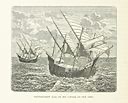
The first known European to have sailed around Africa's southernmost tip, Bartolomeu de Novaes Dias (c. 1450 – 1500) was a squire of the royal household and superintendent of the royal warehouses when João II appointed him to head an expedition to find a trade route to India in October 1486
Little is known of his early life, though he was possibly a descendant of one of Henry the Navigator's pilots. He probably had much more maritime experience than his one recorded stint aboard the São Cristóvão.
The flotilla he was given to carry out the commission consisted of three ships. Dias commanded the São Cristóvão, with Pêro de Alenquer as the pilot. The São Pantaleão had his associate João Infante as commander and Álvaro Martins as the pilot, and a supply ship commanded by Dias’s brother Pêro (a.k.a. Diogo) with João de Santiago as the pilot
Dias' three ships departed from Lisbon in August 1487, replenished their provisions at the Portuguese stronghold of São Jorge de Mina on the Gold Coast and followed the same route as Diogo Cão as far as Cape Cross in Namibia.
The expedition carried six Africans brought to Portugal by earlier explorers who would be dropped off along the coast with gold, silver and messages of goodwill to the local people. The last two Africans went ashore at Angra do Salto in Angola, where the supply ship remained with a nine-man crew.
From there, Dias passed Cão's furthest point, reaching Walvis Bay on 8 December and Elizabeth Bay on 26 December. Violent storms pushed the ships away from the coast on 6 January 1488 and forced them to spend almost a month out of sight of land.
When they turned back to a northward course and sighted land in early February, the vessels had rounded the Cape of Good Hope without sighting it.
As the ships followed the coast eastward, the crews became increasingly restive. By the time they reached Angra da Roca (Algoa Bay), they were unwilling to continue. When Dias called a council of officers in early March, they were unanimously in favour of turning back. Still, they agreed to give him another three days. That took them as far as Rio do Infante (the present-day Great Fish River), where they planted a padrão on 12 March before turning back.
On the return voyage, Dias sighted Cabo das Agulhas (Cape of Needles, Africa's southernmost point) and Cabo das Tormentas (Cape of Storms).
João II subsequently renamed it the Cabo da Boa Esperança or Cape of Good Hope.
Back at Angra do Salto, Dias found only three of the nine he had left to guard the supply ship alive after repeated attacks by locals. One of the trio died on the journey home.
Dias returned to Lisbon in December after an absence of sixteen months at sea and a journey of more than 25,000 kilometres.
Details of Dias's subsequent private meeting with João II are unknown, though he seems to have fallen from favour. He spent some time in West Africa before João's successor, Manuel I, recalled him to serve as a shipbuilding consultant for Vasco da Gama's (c. 1460-1524). Dias helped supervise the construction of the São Gabriel and the São Raphael and sailed with the expedition as far as the Cape Verde Islands before returning to Guinea.
Two years later, he was one of the captains of the thirteen-ship fleet Manuel assembled for the second Indian expedition, commanded by Pedro Álvares Cabral. After making the first official discovery of the coast of Brazil on 22 April 1500, the fleet continued eastwards. They encountered a massive storm on 29 May at what Dias had presciently named Cabo das Tormentas. Four of the thirteen ships, including Dias' command, went down with all hands.
A son and daughter survived Dias. His grandson Paulo Dias de Novais governed Angola and founded the city of São Paulo de Luanda in 1576.