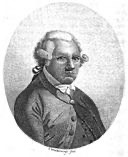
Geographer, hydrographer and propagandist Alexander Dalrymple, born at New Hailes, near Edinburgh, left England in December 1752 to begin a career with the East India Company. His original appointment as a writer failed to eventuate due to an untidy hand. As a result, he spent eighteen months from May 1753 in the storekeeper's office without much prospect of advancement.
His prospects improved when George Pigot succeeded Thomas Saunders as governor and commander-in-chief. Pigot arrived in October 1754 but did not take over his new office until 14 January 1755.
Since Dalrymple had been recommended to him, he had the youngster removed to the secretary's office and reputedly gave him writing lessons "to such good purpose that in a short time he could scarcely distinguish Dalrymple's writing from his own." (John Knox Laughton, Alexander Dalrymple, p. 402.)
Around the same time, the youngster made the acquaintance of council member and historian Robert Orme who assisted him in his studies and gave him the run of his library.
Within a couple of years, Dalrymple had become deputy-secretary, with the prospect of the secretaryship. However, in 1758 he obtained permission for a voyage of observation in the East Indies aboard the Cuddalore.
The French-Irish Jacobite general Thomas Arthur, Comte du Lally's siege of Madras (December 1758 to February 1759), delayed his departure till April. His voyage to the Straits of Malacca in the Winchelsea allowed him to pick up some elementary seamanship along the way.
Dalrymple joined the Cuddalore in June, then spent two and a half years cruising among the islands, negotiating a commercial treaty with the sultan of Sulu before returning to Madras in January 1762.
After his return to Sulu in the London yielded disappointing results, Dalrymple spent another two years in the area before moving on to Canton in November 1764.
His stay in the area coincided with the British occupation of Manila (1762-64). It provided Dalrymple with the first indications of Luis Váez de Torres' voyage to the city almost one hundred and sixty years earlier.
Torres remained a matter of some fascination. Some time after 1790, Dalrymple received and translated a copy of 1607 Torres's report to the Spanish King, which remained unpublished in Spanish until 1878. Dalrymple passed the translation on to James Burney, who included it in his 1806 history of discoveries in the South Sea.
From Canton, Dalrymple returned to London, hoping to advance schemes the Madras government regarded unfavourably. While those notions failed to attract support, his Account of Discoveries in the South Pacific Ocean before 1764 (1767) drew the attention of members of the Royal Society. That, in turn, led to the Society's nomination to lead the 1769 expedition to observe the Transit of Venus in the South Pacific.
Expecting the outright command on the voyage, Dalrymple reputedly selected what he thought would be the most appropriate vessel for the mission. He made other preliminary arrangements before the Admiralty threw a spanner in the works.
First Lord Edward Hawke refused to give the command of a naval vessel - even a recommissioned Whitby collier now named the Endeavour - to a civilian. The position then went to a well-credentialled but relatively unknown naval surveyor named James Cook, who received a promotion to Lieutenant and went on to debunk the notion of a vast, populous Terra Australis Incognita in the South Pacific.
Over the next few years, Dalrymple devoted himself to geographical and hydrographical studies in London before returning to Madras in 1775 as a council member. That did not end well, with a recall after two years on the grounds of alleged (and subsequently unproved) misconduct.
The allegations did not prevent an appointment as the East India Company's official hydrographer in April 1779 or an offer from the Admiralty when they established a similar position in 1795.
Those roles saw Dalrymple collect, collate, and publish charts and administer a significant department with industry and zeal that was not always tempered by discretion. Frequent unpleasantnesses culminated in a summary dismissal from the Admiralty post on 28 May 1808. He died, 'broken-hearted,' just three weeks later.
The Australian Dictionary of Biography describes him as "overbearing, opinionated and cantankerous, but also intelligent, enthusiastic and determined", "ever ready to indulge in violent controversy" and notes "constant disputes with the East India Co. and the Admiralty, ... [and] a foolish and unnecessary vendetta against Cook."
On the last matter, Dalrymple's biographer Howard Fry paints a somewhat different picture.
In Fry's reading of events, Dalrymple felt Cook could have done more to investigate reported sightings of Terra Australis Incognita on his way to Tahiti.
After Cook's second voyage, Dalrymple "Dalrymple had no further grounds for complaint, since the south Pacific had now been very thoroughly investigated, as he had wished, and in the most masterly manner imaginable."
The main target of Dalrymple's ire was John Hawkesworth's official account of Cook's first voyage, which Dalrymple felt underplayed his contribution to the expedition.
His works included a two-volume Historical Collection of the Several Voyages and Discoveries in the South Pacific Ocean, along with thousands of nautical charts produced under his direction and significant contributions to maritime safety.
Dalrymple also opposed the penal colony in New South Wales, publishing A Serious Admonition to the Public on the Intended Thief-Colony at Botany Bay (1786), where he argued that the proposal was an attempt to violate the East India Company's monopoly.
Sources:
- Jim Bain Uncertain Beginnings
- Andrew S. Cook, Alexander Dalrymple (1737–1808)
- Bronwen Douglas, Mapping the Once and Future Strait: Place, Time, and Torres Strait from the Sixteenth Century to the Pleistocene
- Howard T. Fry, Alexander Dalrymple and Captain Cook: The Creative Interplay of Two Careers
- John Knox Laughton, Alexander Dalrymple, Dictionary of National Biography, 1885-1900, Volume 13 pp. 402-3.
- R.H. Major, Early Voyages to Terra Australis
- Michael Pearson, Great Southern Land: The Maritime Exploration of Terra Australis