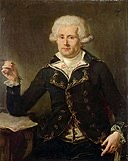
French soldier, diplomat, mathematician, admiral and explorer Louis-Antoine, Comte de Bougainville (1729 – 1811) was born in Paris, the youngest of a notary's three children.
At age twenty-five, he studied law and mathematics. He published a treatise on integral calculus as a supplement to De l'Hôpital's Des infiniment petits.
In 1753, he joined the French army's elite corps of guards, the Black Musketeers (Mousquetaires noirs), before serving as the third secretary to the French Embassy in London, where, his background in calculus, geometry and astronomy saw him elected as a fellow of the Royal Society.
Three years later, he transferred to Canada as a captain of dragoons and aide-de-camp to the Marquis de Montcalm.
He served with distinction in Canada during the Seven Years' War in the capture of Fort Oswego (1756) and the 1757 Battle of Fort William Henry. After being wounded while defending Fort Carillon in 1758, he returned to France for the winter with orders to seek additional military resources for Canada.
While he was unsuccessful in that regard, Bougainville received the Cross of St Louis and a promotion to colonel.
Back in North America the following year, Bougainville participated in the defence of fortified Quebec, patrolling the St Lawrence's north shore upstream from the city. His troops managed to prevent several attempts to land and cut communications with Montreal. However, he could not rally them for a counterattack after the British ascended the Plains of Abraham and took Quebec on 18 September.
From there, he participated in the French defence of Montreal and the last stand at Saint Helen's Island off Montreal before the French capitulated in 1761.
After the French Surrender, Bougainville directed the evacuation of the French forces and organised the exchange of prisoners.
Back in Europe, prohibited under the terms of surrender from active duty against the British, Bougainville participated in the 1761 campaign in Germany. He spent the rest of the Seven Years' War as a diplomat, helping to negotiate the Treaty of Paris in 1763.
With the war over, Bougainville devised a plan to establish a French colony in the Isles Malouines (Falkland Islands) as a port of call for French vessels bound for the Pacific. Bougainville used some of his financial resources to purchase and fit out the frigate Aigle and the sloop Sphinx. His uncle and cousin provided additional finance. Acadian families deported from the North American maritime provinces provided the settlers.
Bougainville set out from France on 15 September 1763, accompanied by the priest, naturalist and writer Antoine-Joseph Pernety (a.k.a. Dom Pernety) and engineer and geographer Lhuillier de la Serre.
After landing at Port Louis in French Bay (later Berkeley Sound) in late January 1764, Bougainville conducted a formal possession ceremony on 5 April 1764. He then returned to France. Louis XV formally ratified possession on 12 September 1764.
However, the settlement would not last.
Spanish fears that the Falklands would become a base for attacks on South America's Pacific coast saw the French government order Bougainville to sell his colony to Spain.
Still, Bougainville would not be out of pocket: he received 200,000 francs in Paris, with another 500,000 francs to be paid in Buenos Aires. Spain would maintain the colony in Port Louis, preventing Britain from claiming the islands.
In the meantime, Bougainville received permission from Louis XV to circumnavigate the globe and sailed from Nantes on 15 November 1766 with two ships.
The frigate Boudeuse (Nicolas Pierre Duclos-Guyot) carried a crew of 214, including Count Jean-François de Galaup de la Pérouse, astronomer Pierre-Antoine Veron, surgeon of Dr. Louis-Claude Laporte, botanist Philibert Commerçon and his (supposedly male) valet, later revealed as Jeanne Baré. She was presumably Commerçon's mistress and became the first woman known to circumnavigate the globe.
The storeship Étoile's 116-man complement included surgeon Dr. François Vives, engineer and cartographer Charles Routier de Romainville and the writer and historian Louis-Antoine Starot de Saint-Germain.
It would become the first expedition to circumnavigate the globe with professional naturalists and geographers.
So Bougainville met the new Spanish governor of the islands, Don Felipe Ruiz Puente, on 31 January 1767 at Río de la Plata to transfer possession and evacuate the French population.
Bougainville and Ruiz Puente proceeded to the Falklands from the River Plate, making a rendezvous in Berkeley Sound on 24 March 1767.
Bougainville relinquished command on 1 April. Ruiz Puente took possession and hoisted the Spanish colours on 2 April, with a 21-gun salute at sunrise and sunset from ships and shore. And so the Isles Malouines became Las Malvinas.
With his Falklands colony dismantled, Bougainville's orders directed him towards Term Australis Incognita and new sources of trade. The Treaty of Paris had destroyed the French India Company's century-old monopoly over trade in the East, leaving room for new players.
So Bougainville sought another sea route to the Orient and possible bases to support it, to replace what France had relinquished.
So Bougainville turned to winter in Rio de Janeiro, where Commerson gathered botanical specimens, including the multi-coloured climbing vine he named in the commander's honour.
Later in the year, Bougainville turned south again. After a difficult passage through the Straits of Magellan, he tracked across the Pacific.
The French ships sighted islands in the Tuamotus on 22 March. They encountered Tahiti in early April, less than a year after Samuel Wallis.
Like his English counterpart, Bougainville claimed the island for his king. Wallis had named it King George the Third's Island. Bougainville opted for a classical reference (Nouvelle Cythere or "New Cythera' — a nod to the Mediterranean island Greek mythology associated with Aphrodite, the goddess of love.
As Commerson went about botanising, assisted by his 'valet', the locals were not fooled. Tahiti was where Jeanne Baret's identity was revealed.
When the ships departed in mid-April, they had acquired a passenger. Aotourou, a young relative of the Tahitian chief, wanted to accompany them. Bougainville thought he might prove a helpful intermediary at neighbouring islands as they made their way through Polynesia.
From Tahiti, Bougainville sailed westward, aiming to locate Terra Australis Incognita, but encountered southern Samoa and the New Hebrides (Vanuatu) instead.
After confirming that Espiritu Santo was an island and not part of any larger landmass, Bougainville approached the Great Barrier Reef early in July 1768. After two days' seeking a passage through the line of breakers and barely submerged coral, he finally set a course to the north.
It was a sensible decision. With a hungry and weakening crew, Bougainville was surrounded by fields of shallow coral, and adverse winds may have cut off any escape.
If he had managed to find a way through, he might have encountered Australia's east coast around Lizard Island, north of today's Cooktown.
In any case, Bougainville "had no faith whatever in the reports of the existence of Torres Strait. Had he persevered, he would have snatched from Cook the honour of the complete exploration of Eastern Australia, and of the verification of the passage between it and New Guinea. Bougainville paid dearly for his caution, as he found that retracing his steps against the trade wind, in order to pass eastward and northward of New Guinea, occupied such a weary time, that he and his people were nearly starved before they reached a place of refreshment." ( W.J.L. Wharton (ed.), Captain Cook's Journal, Thursday, 23rd. August 1770 n.)
A combination of dangerous reefs and hostile locals in the Solomon Islands prevented landings there. The situation in New Ireland was the same, so the expedition made for the Dutch East Indies via the Moluccas.
A short stopover at Batavia delivered news of the Wallis and Carteret voyages. Still, concerns about disease and the impending monsoon season kept Bougainville's ships moving.
Commerson and his 'valet' alighted when they reached Mauritius in early November. So did the astronomer Véron, who planned to observe the Transit of Venus there. Véron subsequently sailed back to the Moluccas on the expedition which secretly brought back clove and nutmeg trees to plant on Mauritius.
Bougainville resumed the voyage in mid-December, leaving the Etoile behind for careening. A further stop in Cape Town revealed that Carteret was not far ahead of the French vessels. Carteret's lead had diminished as they checked in at Ascension Island. A mid-ocean encounter on the home stretch saw Bougainville's envoy pose as a trader on a mission to Sumatra as he attempted to glean information about Carteret's itinerary while not passing on any of his own.
Carteret was unimpressed when he subsequently learned the truth.
When the Boudeuse reached St Malo on 16 March 1769, Bougainville became the fourteenth circumnavigator and the first French commander to do so. Magellan's fleet may have included one Richard of Normandie. The expedition's extremely low death toll (seven deaths out of three hundred and forty) was considered a credit to an enlightened commander.
Although he made few significant discoveries and brought back little scientific material, Bougainville "painted a vivid picture of life in the South Seas, with the result that the expedition captured the public imagination and laid the foundations for subsequent voyages of discovery". (Elliott Forsayth, The French Exploration of the Pacific in the Eighteenth Century, p. 94.)
After a round of celebrity engagements alongside Aotourou, Bougainville settled down to write his account of the voyage. It appeared as Le voyage autour du monde, par la frégate La Boudeuse, et la flûte L'Étoile (a.k.a. Voyage autour du monde and A Voyage Around the World) in 1771.
Shortly before its publication Bougainville underwrote part of the cost of Aotourou's return to Tahiti on Marion Dufresne's follow-up voyage. However, the Tahitian died of smallpox off Madagascar in October 1771 without sighting his homeland.
With its descriptions of Argentina, Brazil, Patagonia, Tahiti and Indonesia, Voyage autour du monde was a sensation. His descriptions of Tahitian society, an earthly paradise where men and women lived in blissful innocence removed from corrupt civilisation, influenced emerging notions of the noble savage.
However, Bougainville's experiences elsewhere in the Pacific meant he did not labour under many delusions.
During the American War of Independence (1776-82 ), the resumption of hostilities with Britain saw Bougainville called back to serve in the West Indies and North American waters. He played important roles in French victories at the Battle of the Chesapeake and off the coast of Yorktown.
Bougainville commanded the 80-gun Auguste at the Battle of the Saintes (1782). He managed to rally eight French ships and bring them safely into Saint Eustace after the French defeat.
After a promotion to chef d'escadre, he re-entered the Army, where he was commissioned as maréchal de camp.
After the Peace of Paris, Bougainville split his time between a family estate in Normandy and Paris and assisted with the preparations for the La Pérouse expedition, which sailed in August 1783. He subsequently played a similar role in the leadup to the d' Entrecasteaux voyage (1791-93) and Baudin's 1800-04 voyage.
Although he became an associate of the Académie de Marine, a proposed voyage to the North Pole did not gain government support.
He became a member of the French Academy of Sciences in 1787 and received a promotion to vice-admiral in 1791.
Although he remained an unashamed royalist, Bougainville's prestige kept him relatively safe through the French Revolution's turmoil. However, he spent time in prison in what may have been a narrow escape from an appointment with the guillotine. After the Reign of Terror ended with Robespierre's beheading, Bougainville retired to his estate in Normandy.
He became a founding member of the Bureau des Longitudes in 1795 and a member of the Institute of France a year later.
During the Napoleonic era, 'the old royalist' was named a senator in 1799 and received a generous pension. Bougainville became a Grand Officier de la Légion d'honneur in 1804, and received the title of Comte de Bougainville three years before his death in August 1811. After a state funeral, his ashes were placed in the Pantheon in Paris.
Sources:
- Felipe Fernandez-Armesto (ed.) The Times Atlas of World Exploration, London, Harper Collins, 1991
- Jim Bain Uncertain Beginnings, Glen Waverley, Sid Hartha Publications, 2011
- Noelene Bloomfield, Almost a French Australia: French-British Rivalry in the Southern Oceans, Canberra, Halstead Press, 2017
- Margaret Cameron-Ash, Lying for the admiralty: Captain Cook's Endeavour voyage, Kenthurst, NSW: Rosenberg Publishing Pty Ltd 2018
- C. B. Dear and Peter Kemp (eds), The Oxford Companion to Ships and the Sea, Oxford, Oxford University Press, 2007
- William Eisler, The furthest shore: images of Terra Australis from the Middle Ages to Captain Cook, Cambridge, Cambridge University Press, 1995
- Miriam Estensen, Discovery: The Quest for the Great South Land, St Leonards, Allen & Unwin, 1998
- Alan Frost, Science For Political Purposes: The European Nations' Exploration of the Pacific Ocean 1764-1806, in C. Martinez Shaw (ed.) Spanish Pacific. From Magellan to Malaspina, Barcelona, Ministerio de Asuntos Exteriores, 1988
- Elliott Forsayth, The French Exploration of the Pacific in the Eighteenth Century, in John Hardy and Alan Frost (eds) Studies from Terra Australis to Australia, Canberra, Australian Academy of the Humanities, 1989
- Magnus Magnusson (ed) Chambers Biographical Dictionary, Edinburgh, W. & R. Chambers Ltd, 1990
- Evan McHugh 1606: An Epic Adventure, Sydney, UNSW Press, 2006
- Neil Rennie, Far-fetched facts: the literature of travel and the idea of the south seas, Oxford, Clarendon Press 1995
- Avan Judd Stallard, Antipodes: In Search of the Southern Continent, Clayton, Monash University Publishing, 2016
- Robert Tiley, Australian Navigators: Picking Up Shells and Catching Butterflies in an Age of Revolution, Sydney, Kangaroo Press, 2002.
- Helen Wallis (ed.) Carteret's Voyage Round the World 1766-69, Cambridge, The Hakluyt Society, 1965
- W.J.L. Wharton (ed.), Captain Cook's Journal During His First Voyage Round The World made in H.M. Bark "Endeavour" 1768-71, London, Elliot Stock, 62 Paternoster Row, 1893
- Wikipedia
- Glyndwr Williams, Buccaneers, explorers and settlers: British enterprise and encounters in the Pacific, 1670-1800, Aldershot, Ashgate Variorum, 2005