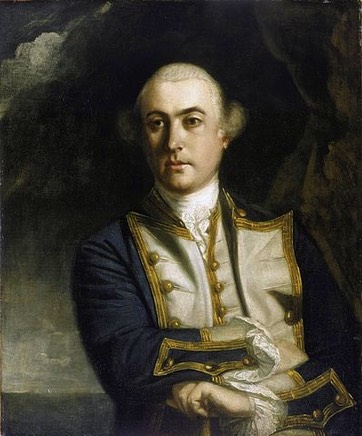
 British naval officer Vice-Admiral John Byron (1723 – 1786), a.k.a. 'Foulweather Jack' due to frequent encounters with severe weather while at sea, was the grandfather of the noted poet Lord Byron.
After joining the Royal Navy in 1731, he served in the 54-gun fourth-rate Romney before a 1740 appointment as a midshipman aboard H.M.S. Wager, one of the squadron Commodore Anson took into the Pacific. His adventures after being shipwrecked on the coast of Chile in 1741 helped inspire his grandson's Don Juan.
The Wager's Captain, Dandy Kidd, died before the ship reached Cape Horn, with Lieutenant David Cheap promoted to acting captain. As the squadron rounded Cape Horn in terrible weather, the vessels scattered, and the Wager turned north before she had sailed far enough to the west to clear the land.
On 14 May 1741, the ship entered a large, uncharted bay and was in no condition to work her way back out to sea. Acting Captain Cheap dislocated his shoulder when he fell down the quarterdeck ladder and was confined below deck.
The disabled ship struck rocks early the following morning and broke her tiller. While remaining afloat, she took in enough water to drown those below deck who were too ill to get out of their hammocks.
Later in the morning, the ship ran aground on what became known as Wager Island. A complete breakdown in authority followed. While one hundred and forty officers and crew members made their way ashore in the ship's boats, others broke out the spirits, got drunk and began looting the vessel and fighting among themselves. Most of those who remained aboard drowned when the ship broke up the next day.
Since officers' commissions at the time were only valid for the ship to which they had been appointed. No one was in a position to exert anything approaching official authority; in-fighting saw the wreck survivors split into two parties.
One, numbering eighty-one, led by the gunner, Mr Bulkley, took to small boats planning to make their way back to England via Rio de Janeiro.
Another party of around twenty, including Acting Captain Cheap and Byron, remained on Wager Island and then set out to row north along the coast of Chile. An initial attempt to do so was unsuccessful, and they were forced back to Wager Island in early February 1742. By that stage, the group numbered thirteen.
A second attempt, guided by a local Indian, saw two men die en route and another six rowed away, never to be seen again. Their guide agreed to carry the remaining five, including Cheap and Byron, the rest of the way to Chiloe Island by canoe in return for a musket, their only remaining possession.
While they were taken prisoner after arriving, the Spaniards treated them well, thanks to Anson's generous treatment of prisoners he had taken during his voyage across the Pacific. They were eventually taken to Santiago, where they remained until late 1744. Released on parole. Byron and the other three were offered passage on a French ship bound for Spain. Three accepted, with the other electing to take a mule across the Andes and return via Montevideo. The whole quartet eventually made their way back to Britain, where survivors of Bulkley's group joined them.
Byron's adventures along the way are recounted in The Narrative of the Honourable John Byron (1768), which includes the story of his later circumnavigation and sold well enough to be reprinted several times.
During his absence, Byron had been promoted to Lieutenant. Immediately after his return, he received a second promotion (to Commander). On 30 December 1746, he was appointed to the 20-gun sixth-rate frigate Syren.
After the treaty of Aix-la-Chapelle ended the War of the Austrian Succession in 1748, Byron commanded a succession of third and fourth-rate ships of the line and the guardship at Plymouth. He also took part in Edward Hawke's aborted expedition against Rochefort in 1757.
After a further spell on blockade duty off the French coast in the America, he commanded a squadron in Canadian waters during the Seven Years' War, supervised the demolition of Louisbourg's fortifications and defeated the French flotilla sent to relieve New France at the Battle of Restigouche. From there, he returned to England and commanded the Fame as part of the squadron before Brest.
So, at the end of the Seven Years' War, with a reasonably impressive string of achievements, Byron needed a peacetime role right when British interest in the Pacific was reviving.
In the wake of Anson's circumnavigation of 1740–44 and more than likely at Anson's suggestion, in 1749, the First Lord of the Admiralty, Lord Sandwich, came up with a plan to send British ships to the Falkland Islands and then into the Pacific. From the Juan Fernandez Islands, they were to head due west, searching for islands or undiscovered land that could be used as a base from which merchants could break into the closed markets on Spanish America's Pacific coast.
Preparations for the expedition were carried out openly. When details reached Madrid, the Spanish authorities, familiar with Anson's suggestions about the matter, protested vehemently. Since the British government was conducting trade negotiations with Spain at the time, the expedition was cancelled.
Anson died in 1762, and Sandwich had been dismissed from the Admiralty.
In 1764 the new First Lord, Lord Egmont, decided to launch a modified version of Anson's 1749 plan. The main point of the exercise was to find a suitable site in the South Atlantic for a settlement where ships could refit and resupply on their way to the Pacific via Cape Horn.
Egmont described the Falklands as 'the key to the whole Pacific Ocean' because of their dominant position just east of the Strait of Magellan.
Since Spain claimed the Falklands but had not occupied the islands, there would be objections to an overt scheme to claim them. So preparations for the expedition were a somewhat furtive affair. Only the Admiralty and George III knew the full details. Most members of the government were kept in the dark to avoid a repetition of the 1749'episode when diplomatic considerations forced the cancellation of the Falklands and South Sea venture.
Egmont's papers include a long series of related memoranda by former South Sea Company factor Henry Hutchinson. possibly as early as the 1730s. They extolled the advantages Britain would gain from a secure presence in the South Pacific. While the chronology of the documents is unclear, they influenced Anson's expedition. They may have been updated as new information and new strategic possibilities emerged. However, it is clear that Hutchinson's son passed these papers to Egmont between 2 January 1763 and 6 October 1765.
In the official version of the mission, Byron, in the 24-gun frigate H.M.S. Dolphin, one of the first British warships with a copper-sheathed bottom, accompanied by Patrick Mouat in the 20-gun sloop Tamar, was on his way to take over command of the Navy's East Indies Station.
The decision to send the expedition was made sometime between the middle of 1763 and early March 1764, when Byron wrote to the Dolphin's Lieutenant Philip Carteret, telling him to hurry to London.
Byron's two ships set sail in June 1764, crossed the Atlantic over the southern winter and made their way slowly down the South American coast to Rio de Janeiro. On 22 October, Byron revealed his secret orders to a crew who thought they were bound for the Far East. At the same time, he demonstrated the first signs of a disinclination to follow his instructions.
The orders pointed him towards Pepys Island off the coast of Patagonia, reputedly discovered by Ambrose Cowley in 1683, and suggested that he approach it from the east.
While he was directed to the Cape of Good Hope and instructed to proceed westwards between 33 and 53°S, he was allowed an alternative.
If circumstance dictated, he could start from Rio and search inside those latitudes from west to east for three hundred leagues.
If unsuccessful, he was to backtrack to the Falklands and claim them.
In either location, he was 'to make purchases, with the consent of [the] Inhabitants, and take possession of Convenient Situations', locate suitable harbours, and then proceed into the Pacific for the second set of objectives.
Those objectives involved Terra Australis Incognita and the search for a route to Hudson's Bay through the long-sought Northwest Passage. If found, he could return home that way, but if that quest was unsuccessful or provisions were short, he could cross the Pacific and return via the Indies.
Byron seems inclined to take the shortest route that his instructions permitted. He started by ruling out the suggested approach to Pepys Island via the Cape of Good Hope and headed instead for Port Desire (Puerto Deseado) in Patagonia. He arrived there on 18 November 1764 and noted the presence of remarkably tall natives, to whom 'The Stoutest of our Grenadiers would appear nothing' in his journal. That would bring him a degree of grief when John Hawkesworth's somewhat romanticised version of the journal appeared in print in 1773.
From Port Desire, Byron headed out into the South Atlantic. He reached Cowley's coordinates for Pepys Island in January 1765, but there was no sign of the island.
When it became clear that searching for the non-existent island was pointless, Byron headed for the Falklands. He anchored at a place he named Port Egmont and formally claimed the islands for George III.
Although he made a cursory inspection of West and East Falkland, Byron failed to notice the French settlement Louis de Bougainville established on East Falkland's Berkeley Sound. However, he needed to rendezvous with the storeship H.M.S. Florida at Port Desire to replenish supplies before venturing into the Pacific.
After leaving the Falklands on 28 January, Byron was back in Patagonia on 5 February. He resupplied his vessels and took the Florida into the Straits of Magellan. She was still with him when he met Bougainville on his second Falklands voyage.
Byron sent the Florida home from Port Famine with news of the encounter, details of his progress and a remark that 'Our Ships are too much disabled for the California Voyage'.
The immediate result of the news was a British settlement on the Falklands, beginning a three-way tussle over the islands with France and Spain.
According to his instructions, Byron was then to make his way into the Pacific, track west, keep as far south as possible and locate the Great South Land, thought to lie between New Zealand and Patagonia.
From there, he was to proceed to New Albion (Drake's name for California) and search for Juan de Fuca's Strait. That was supposedly the Pacific outlet of the long-sought Northwest Passage across the top of North America. If the search succeeded, the Passage would provide a way back to England. If the search was unsuccessful, he could return home across the Pacific via the East Indies and the Cape of Good Hope.
Even a cursory attempt to follow those directions was bound to be time-consuming.; There is already a hint of disinclination on Byron's part to take his time on his investigations. That is, in one way, understandable. Scurvy tended to appear around the hundred-day mark into a voyage, and the passage through the Straits of Magellan took two months. Heading west in search of the South Land would, almost inevitably, bring on the disease, so it probably made sense to make for a known destination where the crews could recover.
Moreover, there was another consideration. The westerly winds Byron encountered once he made his way into the Pacific were always likely to push him too far to the north to seek his next objective.
So Byron crossed the Pacific along the usual northwesterly route between the Tropic of Capricorn and the Equator. That was more or less the course proposed for Anson's proposal back in 1749. His reversion to the 1749 plan may account for the lack of formal censure for a clear breach of his written orders. In Byron's version of events, he hoped to locate islands, specifically the long-sought Solomon Islands, first discovered in the sixteenth century but subsequently lost along this track.
In his own words, he decided to 'make a N.W. Course til we get the true Trade wind, and then to shape a Course to Wtward in hopes of falling in with Solomons Islands if there are such, or else to make some new Discovery'.
Still, that track took him too far to the north to run among the atoll clusters of the central Pacific, so he crossed the Pacific without making significant discoveries. Several small islands in the Tuamotus, where he could not anchor, appear on his charts as the Islands of Disappointment. He narrowly missed sighting Tahiti but claimed to have seen signs indicating the proximity of a southern continent:
Sunday, 16 June*. Wind East with a mountainous Swell from the S°ward. For a day or two before we made the Islands of Disappointment till this day we had entirely lost that great Swell & for some time before we first made the Land we saw vast Flocks of Birds which we observed towards Evening always flew away to the S°ward. This is a convincing proof to me that there is Land that way, & had not the Winds failed me in the higher Latitudes
as mentioned before, I make no doubt but I should have fell in with it, & in all probability made the discovery of the S" Continent; Indeed if it had not been for the Sickness in both Ships, I would still have attempted it by hauling away to the S°ward immediately from those Islands. I remarked before that all the Islands we have seen are well peopled; Now, if there are not a Chain of Islands reaching to the Continent, how can we account for these Peoples being here, situated, we may say in the middle of this vast Southern Ocean. (Byron's Journal, pp. 104-105)
Critics might question why Byron failed to investigate further. The reference to sickness in both ships and his subsequent description of his transit across the Pacific as 'the longest, hottest, & most dangerous Run that was ever made by Ships' indicate an interest in getting somewhere else.
Water was running short, and after sighting 'Byron's Island' in Kiribati on 4 July, he reached Tinian at the end of the month. A two-month stay there allowed the crews to recuperate. He put to sea again on 1 October, reached Batavia on 28 November, but remained there for less than a fortnight. By 14 February 1766, he was at Cape Town and left for home early in March.
When he brought the Dolphin to anchor in the Downs on 9 May 1766, Byron had completed the fastest circumnavigation, and the first accomplished in less than two years. Regardless of the niggling concerns expressed in his journal, he had done it relatively untroubled by scurvy. The Dolphin's copper-sheathed bottom survived the voyage in good condition. In less than three months, she was ready for another circumnavigation under a new commander, Samuel Wallis.
Analysis of Byron's voyage tends to focus on the negatives.
While he ignored instructions and made no significant discoveries, Byron's speculation in his journal coincided with the publication of John Callander's Terra Australis Cognita, an almost straight copy of Charles de Brosses' Histoire des navigations aux terres australes (1756).
He reported portents of future discovery, told Lord Egmont what he wanted to hear and did enough to spur on the Admiralty, who knew that the French had similar designs on the southern continent.
Wallis was sent out in pursuit of some of the same objectives. Thanks to Byron's wishful reading of the swell and the birdlife followed a track to the south of Byron's and, as a result, discovered Tahiti in 1767.
Moreover, there was another legacy. The instructions Byron ignored did not reach six pages in length, restricted themselves to routine nautical observations and left a deal to the commander's discretion. Instructions for those who followed him were much more detailed and specific.
Byron's account of his circumnavigation appeared in The Narrative of the Honourable John Byron (1768), which sold well and was reprinted several times.
Byron's failure to deliver the desired results did not affect his subsequent career prospects. He succeeded Hugh Palliser as governor of Newfoundland (1769—72), attained flag rank as a Rear Admiral on 31 March 1775, and moved on to Vice-Admiral on 29 January 1778. That should have seen him go to India as the naval commander in the East.
Reports a French fleet under Comte d'Estaing in Toulon was North America-bound, saw Byron's squadron diverted to pursue d'Estaing and bring his force to battle.
In the 90-gun second-rate Princess Royal, Byron headed into the Atlantic in June 1778, but gales scattered Foulweather Jack's squadron. When the ships eventually reassembled in New York, the ships were in no state to put to sea. When they did, in October, D'Estaing was in Boston. Byron set out to intercept them, once again had his for ships dispersed by gales, and eventually caught up with d'Estaing in the West Indies after yet another encounter with adverse weather.
Byron's storm-battered squadron arrived at St Lucia, recently captured by Samuel Barrington's Leeward Islands squadron and troops under General James Grant, on 6 January 1779. D'Estaing lurked over the horizon in nearby Martinique.
Byron ended up merging the two squadrons, with Barrington as second-in-command and set about trying to lure d'Estaing's forces into battle. In June 1779, he took his fleet to St Kitts to cover the departure of the trade convoy to England. While he was away, a small force from Martinique captured St Vincent while d'Estaing's fleet landed troops on Grenada. Byron rushed to Grenada in the belief that the island was holding out.
An inconclusive action off Grenada on 6 July 1779 saw three of Byron's ships badly damaged as d'Estaing made little attempt to exploit a slight numerical advantage.
Byron eventually withdrew to St Kitts, fortunate that the French did not take his three crippled ships. The second encounter in Basseterre Roads, St Kitts, on 22 July saw the French withdraw, heading back to North America, while Byron returned to England due to ill health.
He was briefly Commander-in-Chief of the North American Station from 1 October 1779, promoted to Vice-Admiral of the White in September 1780 and was reputedly offered the command in the Mediterranean but declined it on the grounds of ill health. He died at home in London on 10 April 1786.
He was survived by his wife, who died in 1790, three daughters who married well, and two sons. The elder, John, a.k.a. Mad Jack (1756–1791), was the poet's father. The second son, George Anson (1758–1793), a naval officer, distinguished himself in the lead-up to the decisive victory at the battle of the Saints, off Dominica, on 12 April 1782.
Perhaps because details of the expedition appeared in Hawkesworth's Voyages, Byron's voyage has usually been seen as a precursor to the more dispassionate and scientific expeditions that followed.
In reality, it was a throwback to the anti-Spanish voyages of Drake, Dampier, and Anson, the abortive 1749 expedition writ large before the focus changed.
Sources:
Felipe Fernandez Armesto, Pathfinders: A Global History of Exploration,
Chambers Biographical Dictionary
Felipe Fernandez-Armesto (ed.) The Times Atlas of World Exploration
Alan Frost, Science For Political Purposes: The European Nations' Exploration of the Pacific Ocean 1764-1806
Alan Frost, Shaking off the Spanish Yoke: British Schemes to Revolutionise America, 1739-1807
Alan G. Jamieson, John Byron (1723–1786) Oxford Dictionary of National Biography
David Mackay, The Great Era of Pacific Exploration
G. A. Mawer Incognita: The Invention and Discovery of Terra Australis,
Evan McHugh 1606: An Epic Adventure
O.H.K. Spate The Pacific Since Magellan, Volume III: Paradise Found and Lost,
Avan Judd Stallard, Antipodes: In Search of the Southern Continent,
Robert Tiley, Australian Navigators: Picking Up Shells and Catching Butterflies in an Age of Revolution
Richard Walter (ed.) A Voyage Round The World
Wikipedia
Glyndwr Williams, The Endeavour Voyage: A Coincidence of Motives,
Glyndwr Williams. Buccaneers, explorers and settlers: British enterprise and encounters in the Pacific, 1670-1800
Glyndwr Williams. The expansion of Europe in the eighteenth century, overseas rivalry, discovery and exploitation